
Issue 51: When Shadow AI Triggers an SEC Form 8‑K filing under Item 1.05
One Employee, One Prompt, One 8-K: What Community Bank's Shadow-AI Disclosure Means for Boards

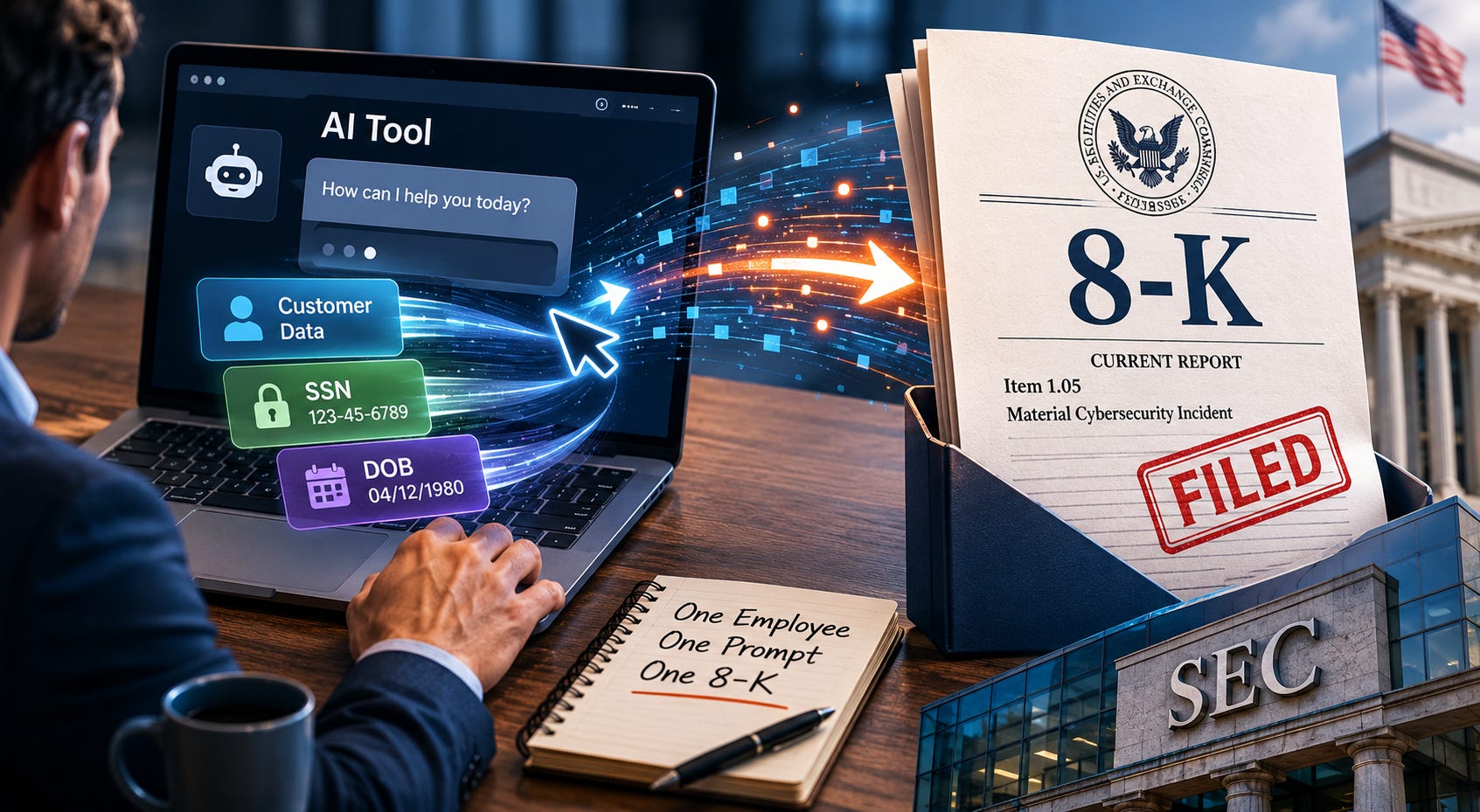
Shadow AI turns one employee shortcut into a disclosure-control problem.
Every board wants AI efficiency. No board wants to explain why an employee pasted customer Social Security numbers into an unauthorized chatbot.
But that is no longer a hypothetical governance exercise. It is now sitting in an SEC filing.
On May 5, 2026, Community Bank, a regional bank in Pennsylvania, stumbled into exactly that scenario. The bank became aware that an employee had been handling non‑public customer information using an unauthorized AI‑based software application. Names, Social Security numbers, dates of birth - the full identity‑theft starter kit - were fed into a tool IT never approved.
By May 7, the bank’s parent, CB Financial Services, had determined the incident was material under the SEC’s cybersecurity rules because of the volume and sensitive nature of the information involved. On May 11, it filed a Form 8-K under Item 1.05, disclosing that sensitive customer data had been handled using an “unauthorized artificial intelligence-based software application,” even though core systems were never breached and operations never went down.
That combination - no hacker, no outage, but a material SEC cyber disclosure anyway - is the part that should make boards sit up.
It takes one employee, one prompt, and one unapproved tool to turn a quiet efficiency shortcut into a very public securities filing.
Even if your company never files an 8‑K, the pattern still translates. Customers, lenders, acquirers, and plaintiffs’ lawyers do not distinguish between “public” and “private” when highly sensitive data ends up in an unauthorized AI tool; they look at how quickly management detected it, escalated it, and documented the response.
How Did They Even Catch It?
The 8-K doesn’t read like a thriller. It says only that the bank “became aware” on May 5 of an internal incident involving non-public customer information and an unauthorized AI-based application. It does not say how.
That gap matters more than the answer would. Maybe data loss prevention flagged a batch of SSNs heading to an unfamiliar domain. Maybe a reviewer caught output that did not look like it came from an approved tool. Maybe the employee realized, a beat too late, that a chatbot was not where customer identities belong. We don’t know, and the not-knowing is the point.
If an organization cannot say with confidence how it would catch this, it already has its answer about whether it would catch it at all.
What is clear is that the bank moved fast. By May 7, management had assessed the scope, weighed the sensitivity and volume of the data, and concluded the incident was material. That started the SEC’s four-business-day clock, and the 8-K reached EDGAR on May 11. In the same filing, CB Financial said the incident had not had, and was not expected to have, a material impact on its consolidated financial condition or results of operations, underscoring that the materiality call rested on data sensitivity and loss of control, not system disruption or immediate financial damage.
From an Elemental AI governance lens, the signal is straightforward:
The controls did not wait for evidence of fraud or confirmed misuse. The trigger was “someone put highly sensitive data into an AI tool we didn’t authorize,” and that alone was enough to support a materiality determination under Item 1.05.
Which AI Tool Was It?
Everyone wants to know which tool it was, but the bank is not saying. The 8‑K describes an “unauthorized artificial intelligence‑based software application” and nothing more.
Law firm and industry analyses all repeat the same point: the specific application, model provider, or platform has not been publicly disclosed. That silence is telling in its own way. It reminds boards that the risk category is not one bad vendor.
It is any AI tool - consumer or enterprise, chatbot or plug‑in -that can accept raw data from your employees before security, legal, or procurement ever see the contract.
For directors and executives, that is the real lesson. This risk cannot be mitigated by banning one logo. It has to be governed as a behavior pattern: employees reaching for AI on the open internet to get their work done faster, without realizing they are exporting regulated data in the process.
You can’t mitigate this by banning one logo. You have to govern the behavior pattern.
Is This Really the First Shadow‑AI 8‑K?
Law firms tracking cyber 8-Ks are now citing Community Bank as the first clear “shadow AI” driven material incident on the SEC record. Board-cybersecurity practitioners make the same point: in their tracking, this is the first material cybersecurity 8-K where the root cause was employee use of unauthorized AI software, not an external attacker.
There have been plenty of other cyber 8-Ks since the SEC rules came into force -ransomware, data exfiltration by external actors, third-party breaches, and the usual mix of attack vectors. This one is different because it reframes what counts as “cyber.” The threat vector is no longer a hostile outsider exploiting the perimeter. It is an employee using an AI tool the way millions of people have already been trained to do in their personal lives: copy, paste, prompt, repeat.
In other words, the line between “IT security issue” and “everyday knowledge work” just blurred in a very public way.
Have There Been Other AI‑Related Disclosures?
So far, this is the standout case explicitly tied to unauthorized AI use under Item 1.05. But it won’t be the last.
Plaintiff-side firms have already launched investigations and client-intake efforts around the Community Bank incident, framing it as a data breach in which names, Social Security numbers, and dates of birth were exposed via an unauthorized AI tool. Cybersecurity and AI-governance commentary is treating the incident as a template: insider misuse of AI, highly sensitive PII, rapid materiality determination, and a formal SEC disclosure even without a confirmed financial hit or operational outage.
That matters because it sketches the likely next wave. It is easy to imagine another registrant discovering that a well-meaning employee piped health data, payroll files, or deal documents into an AI tool sitting completely outside the company’s contractual and technical perimeter.
Once that pattern is accepted as a “cybersecurity incident,” the disclosure question becomes when, not if.
For private companies, the mechanics look different – there may be no Form 8‑K – but the pressure points are similar. The questions will come from customers, partners, regulators, lenders, and potential buyers: What happened? How was it detected? How fast did you act? How do you know it will not happen again?
Shadow AI: Why It Exists
AI isn’t just a technology you roll out. It’s a data‑handling behavior your employees have already adopted, whether you’ve approved the tools or not. Shadow AI is what happens when that behavior runs ahead of your governance.
Shadow AI does not exist because employees are reckless. It exists because the way work is being done has changed faster than the way tools are approved. When the only officially blessed options are slow, clunky, or blocked altogether, people do what they have been trained to do in their personal lives: open a browser, paste the data, and let an unvetted model solve the problem.
In that sense, shadow AI is often a policy artifact. Overly restrictive or slow-moving approval processes do not eliminate AI use; they push it into channels security, compliance, and legal teams cannot see.
Think about the AI approval process like a carpool lane. Employees are perfectly happy to stay in the official lane as long as it moves faster than the traffic around it. If the carpool lane keeps grinding to a halt, they start looking for gaps in the divider, shoulders to cut across, any way to get back into the main flow. AI works the same way. If “doing it the right way” is slower than opening a browser and pasting into the nearest chatbot, people will quietly exit the lane and take your data with them.
Employees are willing to stay in the lane as long as it moves faster than the traffic around it. When the approval lane stalls, they will find a way out.
That is why the solution is not just more prohibition. Shadow AI is reduced when the approved lane is both safer and faster than the alternatives.
The Verizon 2026 Data Breach Investigations Report makes clear that this is not a fringe phenomenon. Verizon said employee use of unapproved “shadow AI” tripled to 45%, spiking data leakage. Related coverage of the report says shadow AI is now the third most common non-malicious data-leakage activity, rising from about 15% to 45% in one year. Put CB Financial’s 8-K next to that finding and the board-level headline is hard to miss: this is not a one-off failure mode; it is increasingly how data escapes normal control channels.
How Do Employers Get a Handle on Shadow AI?
If shadow AI is a behavior pattern rather than a single bad app, the control question becomes simple: how does the organization make the safe path the easy path?
1. Maintain a vetted set of approved tools
A practical starting point is a small, visible set of approved AI tools - enterprise copilots, productivity assistants, and domain-specific models - with security, privacy, and contractual protections the organization can live with. Those tools need to be easy to access, easy to understand, and governed with clear rules about what data they may and may not touch.
2. Create an accelerated approval lane
The fastest way to stop shadow AI is to make official approval faster than just opening a browser. Organizations need a fast lane where security, privacy, legal, and procurement can say “yes, with these guardrails” or “no, for these specific reasons” in days, not quarters. Employees will stay in the carpool lane if it actually moves. If it does not, they will find a way out.
3. Instrument for detection, not just prohibition
Blocking a handful of URLs will not catch browser extensions, plug-ins, desktop AI apps, or employees using non-corporate accounts. Effective programs combine network controls with endpoint visibility and data-loss prevention capable of spotting sensitive classes of data - PII, health information, financial records- moving to unapproved destinations. The operational test is blunt but useful: if someone uploaded 5,000 records’ worth of your most sensitive customer or employee data (SSNs, health data, salary files, or deal documents) into an unapproved chatbot tomorrow, how confident would management be that the organization would detect it quickly?
4. Treat it as a culture issue as well as a policy issue
Employees who paste regulated data into chatbots are usually not acting maliciously; they are trying to get work done. The better response is not only “don’t do this,” but scenario-based guidance that tells people when approved assistants may be used, when human review is mandatory, and which data simply never belongs in any external model.
When management runs an incident-response exercise, it should not stop at “how would the company respond?” It should go one step earlier: what approved tools and governance paths exist today that would have made the shadow-AI detour less likely in the first place?
What This Means for AI Governance (In Plain English)
This issue lands a simple point. AI is not just a technology deployment issue. It is a data-governance issue, a disclosure issue, an incident-response issue, and increasingly a board-oversight issue.
The Community Bank case shows that the SEC and the market may not wait for a catastrophic breach before expecting disclosure. In this incident, the bank made clear that operations were fine and that customer access, payment systems, and core infrastructure were not disrupted. The problem was that highly sensitive customer data had touched an unauthorized AI platform at all, and the company concluded that fact alone was material enough to report.
That is a meaningful shift. It implies that the sensitivity of the data and the loss of control over where it went can themselves become reportable risk, even before there is evidence of misuse or fraud.
In plain terms, Community Bank treated “we lost control of where this highly sensitive data went” as material and put that judgment on the public record
Regulators are moving in parallel. Commentary on the Office of the Comptroller of the Currency (“OCC”) 2026 risk outlook says the agency is warning that AI is reshaping the cyber threat environment for banks and that institutions remain responsible for the AI tools they and their vendors use. Related analysis also notes that the OCC, FDIC, and Federal Reserve are signaling more formal inquiry into model-risk management as it relates to bank use of AI, pointing toward a more developed supervisory framework. Broader FDIC IT exam commentary for 2026 points to greater focus on governance, cybersecurity, resilience, and vendor management, which are exactly the control domains implicated by uncontrolled AI usage.
Put differently, CB Financial’s 8-K did not land in a vacuum. It landed into a supervisory environment that is already sharpening its expectations around AI governance in financial institutions.
For boards and executives, the core question is no longer “Do we use AI?” It is “Can our organization explain, under pressure, which AI tools employees are using, what data they are allowed to touch, how exceptions are approved, and how misuse is detected?”
The question is no longer whether the company uses AI. The question is whether it can explain, under pressure, how that AI use is governed.
And again, that question is not reserved for public companies. Any organization that handles sensitive customer, employee, or deal data will be expected to answer it - to regulators, to customers, to counterparties, or to a buyer’s diligence team.
Navigator Tip of the Week: Run the Shadow‑AI Fire Drill
A practical exercise for the next risk meeting is a single question:
“If tomorrow our company discovered that an employee uploaded 5,000 records’ worth of your most sensitive customer or employee data (SSNs, health data, salary files, or deal documents) into an unauthorized AI chatbot, walk us through the next 96 hours.”
The discussion should surface several specifics:
How would the organization detect the issue in the first place?
Who owns the investigation?
Who decides whether the incident is material under SEC rules or other legal, contractual, or regulatory obligations?
When do legal, security, compliance, and communications come into the loop?
Does the playbook assume that “no outage” means “no disclosure,” or does it explicitly account for a Community-Bank-style scenario where data sensitivity alone can tip the scales?
If the answers come back vague, optimistic, or heavily vendor-dependent, the board has already found part of its AI-governance agenda for the rest of 2026.
At a minimum, directors should be able to get crisp answers to four questions:
How does the organization currently detect employees using unapproved AI tools with sensitive data?
Who decides whether an AI-driven incident is material, and what criteria are being used?
Which AI tools are formally approved today, and what data are they explicitly barred from touching?
When was the incident-response playbook last tested on a shadow-AI scenario rather than a classic external breach?
The setting matters. This did not happen at a startup with no controls. It happened inside a bank, one of the most heavily regulated data handlers in the economy, operating in a supervisory environment where IT governance, cybersecurity, and vendor oversight are routine points of examination. If one employee with one prompt can export regulated data from inside that control environment, the key question is not whether it could happen elsewhere. It is whether another board would identify the issue, assess materiality, and reach a disclosure decision with the same speed.
That is what this first shadow-AI 8-K really shows. It takes one employee, one prompt, and one unapproved tool to turn a quiet efficiency shortcut into a very public securities filing.
What this 8-K ultimately tests is not only cybersecurity resilience, but also disclosure readiness. Specifically: whether management can recognize that an internal misuse of AI - without any system outage - can still trigger a materiality assessment on day one.
For boards, that shifts the oversight question. This is no longer just “Are we secure?” It is “Are our disclosure controls calibrated to risks that originate inside the firewall, through tools we do not fully govern?”
Because in the shadow-AI era, the speed of the incident is no longer the constraint. The speed of recognition - and escalation - is.
Let’s Get Elemental
If this scenario still feels like a “cyber issue,” you are already one step behind.
Treat it as a disclosure‑controls problem.
At the next board or audit committee meeting, do not ask whether the company is “using AI responsibly.” Ask management to walk through, in concrete terms, how an internal AI‑misuse incident would move from detection to a materiality decision - and who is accountable at each step.
For public companies, that decision point may translate into an SEC filing. For private companies, it may translate into notifications to customers, regulators, lenders, or potential buyers. In both cases, the underlying test is the same: can the organization explain, under pressure, how AI‑driven incidents are recognized, escalated, and communicated?
If that path is unclear, fragmented, or overly dependent on hindsight, then the organization does not just have an AI‑governance gap.
It has a disclosure‑readiness gap.
And that is the gap that turns an internal shortcut into a public filing – or a very difficult conversation with your most important stakeholders.
About Fayeron Morrison
Fayeron Morrison is the President of Elemental AI, a strategic advisory firm that helps boards and executives navigate the governance challenges of artificial intelligence. She is the creator of the Elemental AI Governance Navigator, a diagnostic tool built to bring clarity and accountability to AI oversight at the highest levels.
A graduate of the Stanford Graduate School of Business Executive Program in AI Leadership, Fayeron is also the author of Elemental AI, a weekly Substack publication focused on AI governance, risk, and boardroom readiness.
Beyond her AI work, Fayeron is a Certified Public Accountant (CPA) and Certified Fraud Examiner (CFE) with a long-standing career advising both public and private companies.
She lives in Newport Beach, California with her husband and their Bernese Mountain Dog, Oakley. She’s the proud mom of three grown sons and, when she’s not writing or advising, she’s likely on a hiking trail with Oakley - where she does some of her best thinking!
Get in touch to learn more about the Governance Navigator →